|
 |
|||||||||||||||||||||||||||
 |
|
|||||||||||||||||||||||||||
|
|
|
|
|||||||||||||||||||||||||
|
© GHW Waters Sdn. Bhd. |
|
|
|||||||||||||||||||||||||
|
|
|
|
|||||||||||||||||||||||||



GHW WATERS


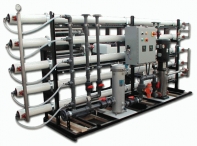
Reverse Osmosis System
Reverse osmosis (RO) is used to reduce dissolved solids from feed waters with salinities up to 45,000 ppm TDS (total dissolved solids). Municipalities and industrial facilities are able to use RO permeate as a consistently pure drinking water supply and to transform drinking water to high purity water for industrial use at microelectronics, food and beverage, power, and pharmaceutical facilities. The technology is also very effective at removing bacteria, pyrogens, and organic contaminants. Reverse osmosis separation technology is used to remove dissolved impurities from water through the use of a semi-permeable membrane. RO involves the reversal of flow through a membrane from a high salinity, or concentrated, solution to the high purity, or "permeate", stream on the opposite side of the membrane. Pressure is used as the driving force for the separation. The applied pressure (P) must be in excess of the osmotic pressure of the dissolved contaminants to allow flow across the membrane. GHW Waters Technologies uses spiral wound membranes - tightly packed filter material sandwiched between mesh spacers and wrapped in a small-diameter tube - to desalt and demineralize process water. The membrane's operating conditions are fine-tuned to balance the flux, or the amount of water which passes through the membrane, with the specific rejection rates of contaminants to achieve up to 99.8% salt rejection at low pressures and high flux rates. A one-stop source for platforms that serve your water purification needs Reverse Osmosis systems from GHW Waters deliver high performance at the lowest life-cycle costs. Our pre-engineered systems are built with high-quality components designed specifically for water purification. They arrive at your facility ready to run with all filters, membranes, pumps, piping, controls and automation. GHW Waters spiral-wound membranes are cost-effective thin-film elements used to remove salts and separate organic material, by molecular weight or particle charge. Our products cover a broad range of applications, including: Desalination Food/beverage process separations Industrial process separations We supply membrane elements, reverse osmosis (RO) systems, filters, pumps, nanofiltration and ultrafiltration equipment and other components. GHW Waters is also unique in our Single Point Accountability for the design and operation of these units. We build the complete machine, but the GHW Waters brand is also on the membrane elements, controls, filters and high pressure pumps to insure quality and responsiveness to your concerns. Water equipment primary components GHW Waters supports you with a wide range of RO system components: GHW Waters can tailor an economical solution that creates value for you while reducing your operating costs. |
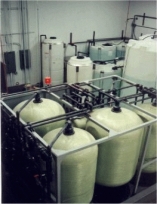
Water Deionization System
The process used for removal of all dissolved salts from water is referred to asdeionization. Deionization requires the flow of water through two ion exchange materials in order to effect the removal of all salt content. Deionization. The terms demineralization and deionization are used somewhat interchangeably by the industry. While the term demineralization is generally better understood, deionization is especially apt. The passage of water through the first exchange material removes the calcium and magnesium ions just as in the normal softening process. Unlike home equipment, deionization units also remove all other positive metallic ions in the process and replace them with hydrogen ions instead of sodium ions. As the metallic ions in the water affix themselves to the exchange material, the latter releases its hydrogen ions on a chemically equivalent basis. A sodium ion (Na+) displaces one hydrogen ion (H+) from the exchanger; a calcium ion (Ca++) displaces two hydrogen ions; a ferric ion (Fe+++) displaces three hydrogen ions, etc. (Recall that home softeners also release two sodium ions for every calcium or magnesium ion they attract.) This exchange of the hydrogen ions for metallic ions on an equivalent basis is chemical necessity that permits the exchange material to maintain a balance of electrical charges. Now because of the relatively high concentration of hydrogen ions, the solution is very acid. At this point the deionization process is just half complete. While the positive metallic ions have been removed, the water now contains positive hydrogen ions, and the anions originally in the raw water. The partially treated water now flows through a second unit, this time an anion exchange material normally consists of replaceable hydroxyl anions and fixed irreplaceable cations. Now the negative ions in solution (the anions) are absorbed into the anion exchange material. Released in their place are hydroxyl anions. |
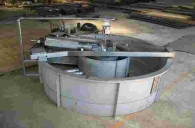
Wastewater Treatment Plant
Water is pumped from wells, rivers, streams, and reservoirs to water treatment plants, where it is treated and distributed to customers. Wastewater travels through customers’ sewer pipes to wastewater treatment plants, where it is either treated and returned to streams, rivers, and oceans or reused for irrigation and landscaping. Operators in both types of plants control equipment and processes that remove or destroy harmful materials, chemical compounds, and microorganisms from the water. They also control pumps, valves, and other equipment that moves the water or wastewater through the various treatment processes, after which they dispose of the removed waste materials. Operators read, interpret, and adjust meters and gauges to make sure that plant equipment and processes are working properly. Operators operate chemical-feeding devices, take samples of the water or wastewater, perform chemical and biological laboratory analyses, and adjust the amounts of chemicals, such as chlorine, in the water. They use a variety of instruments to sample and measure water quality and they utilize common hand and power tools to make repairs to valves, pumps, and other equipment. Water and wastewater treatment plant and system operators increasingly rely on computers to help monitor equipment, store the results of sampling, make process-control decisions, schedule and record maintenance activities, and produce reports. When equipment malfunctions, operators also may use computers to determine the cause of the malfunction and seek its solution. Occasionally, operators must work during emergencies. A heavy rainstorm, for example, may cause large amounts of wastewater to flow into sewers, exceeding a plant’s treatment capacity. Emergencies also can be caused by conditions inside a plant, such as chlorine gas leaks or oxygen deficiencies. To handle these conditions, operators are trained to make an emergency management response and use special safety equipment and procedures to protect public health and the facility. |